
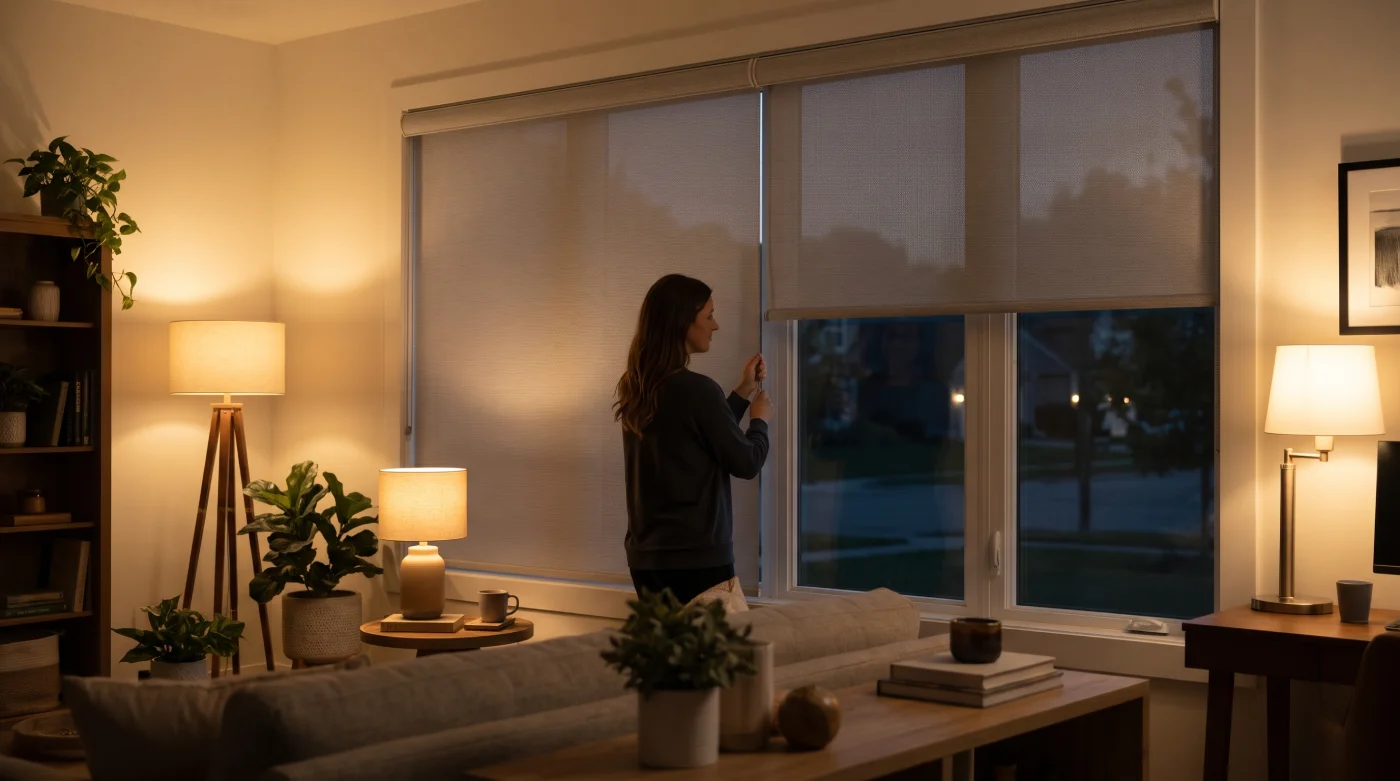
Do solar shades provide privacy at night? Do not assume they do. Solar screen fabric is designed around managing sunlight and preserving a degree of view, and its visibility changes with lighting conditions. A room that appears private during the day can become visible from outside when the interior is lit after dark.
The useful question is how the specific fabric and window arrangement behave under the conditions in your room. Fabric openness, lighting, viewing position, installation gaps, and additional layers all affect that assessment.
For Metro Detroit homeowners considering solar shades, nighttime privacy should be part of the selection conversation before ordering. A daylight sample demonstration alone cannot establish what a neighbor or passerby may see in the evening.
Separate Solar Control From Privacy
A product can help with sunlight-related concerns without providing the privacy you need. Those are different requirements.
Solar shades are commonly selected where the owner wants to manage glare and retain some connection to the view. The exact performance depends on the fabric and system.
Privacy asks another question: what can someone outside see under the conditions that matter? A treatment that works well for a bright daytime office may not satisfy the needs of a lit bedroom after dark.
Write the requirements separately. “Reduce afternoon glare while preserving the view” is one goal. “Prevent outside visibility during evening use” is another. Once both are explicit, the designer can discuss whether one treatment or a layered arrangement is appropriate.
Lawrence Berkeley National Laboratory’s window attachment research discusses several distinct functions, including glare control, thermal comfort, and privacy. Decide which of those functions your room needs before comparing fabrics.
Understand Why Day and Night Look Different
What you see through a screen depends partly on the relative lighting on each side. During daylight, the brighter exterior can make the view outward feel more apparent while reducing what is easily seen from outside.
After dark, an illuminated interior changes that relationship. Furniture, movement, and people may become visible through a screen that seemed private earlier.
Hunter Douglas solar shade guidance describes this day-and-night distinction. Treat it as a reason to evaluate the actual product and room, not as a substitute for a project-specific demonstration.
The important point is practical: assess privacy at the time the room is used. If evening privacy matters, include evening lighting in the decision.
Know What the Openness Factor Does and Does Not Tell You
The solar shade openness factor describes a characteristic of the screen fabric. It is useful when comparing products, but it is not a complete privacy rating for every installed window.
Ask the supplier to identify the actual fabric and explain the relevant specification. Do not assume a smaller number means no one can see inside at night.
The appearance can also be affected by color, construction, viewing distance, and lighting. Compare samples under the same conditions so one variable is not mistaken for another.
Keep the selected product code with the order. Similar-looking sample books can contain different materials, and the approved fabric needs to be traceable when the final shade is made.
Consider Who Can See the Window
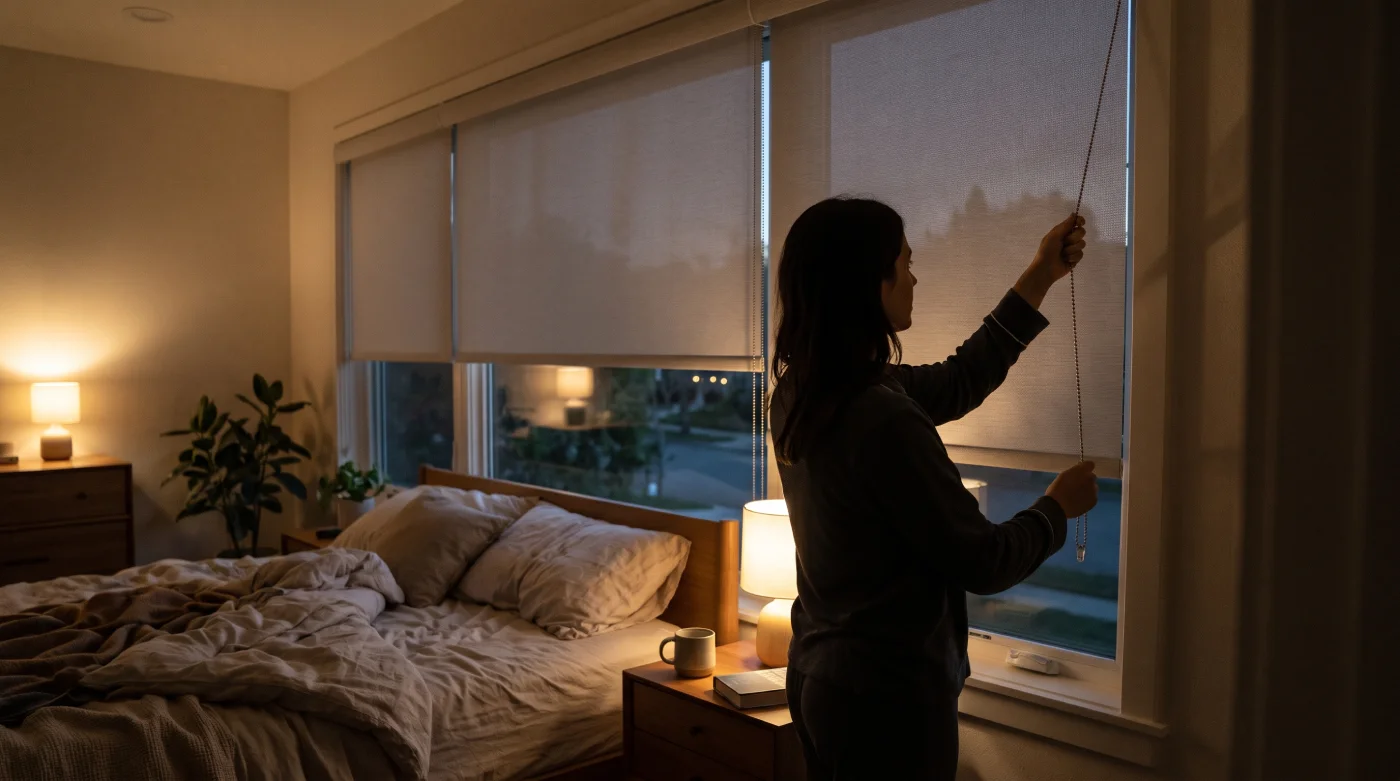
Privacy needs depend on sightlines, not only the room’s name. A bedroom facing a neighboring window presents a different situation from an upper-level room facing an open area.
Describe the outside viewing positions that matter. Include sidewalks, nearby homes, shared outdoor spaces, and the angles from which the room may be visible.
Think about how the room is arranged. A chair, bed, mirror, or bright lamp near the glass can affect what a viewer sees.
Do not rely solely on the distance to the nearest property boundary. A view from another floor or an oblique angle may be more relevant than a direct view from the street. The treatment discussion should reflect the actual surroundings.
Test Samples Under Comparable Lighting
A useful nighttime privacy demonstration compares the same fabric under documented conditions. Keep the room lighting, viewing distance, and camera settings consistent when comparing materials.
Use a full enough sample or demonstration setup to understand the effect. A tiny swatch held against a dark background can make a screen look more opaque than it will appear across a lit window.
Photographs can help record the comparison, but automatic phone exposure may exaggerate or conceal differences. Treat the images as supporting observations, not a certified privacy test.
Only take exterior observations from a place you can access safely and appropriately. If a nighttime test is impractical, explain that limitation and avoid turning an incomplete demonstration into a guarantee.
Include Edges and Installation Gaps
Even an opaque fabric does not automatically eliminate every view around a treatment. Gaps at the sides, meeting points, and other installation details can matter.
Ask how the proposed shade fits the opening and what limitations result from the mounting method, window hardware, or surrounding construction.
A photograph of the fabric itself does not show these details. Review a complete installed example or a drawing that explains how the treatment sits relative to the glass and frame.
If privacy is essential in a particular room, state that clearly. The designer needs to know whether a small perimeter gap is acceptable or whether another arrangement should be considered. Do not assume that “privacy fabric” answers every installation question.
Compare Layering Options by Function
A layered treatment can let different materials handle different tasks. One layer may manage daytime solar concerns while another provides the evening coverage you need.
The second layer could take several forms depending on the room, product range, and installation. Ask which options are actually available and compatible with the window.
Compare how the layers operate, where they stack, and whether both remain accessible. A theoretically useful combination can become inconvenient if controls interfere or furniture blocks daily use.
Also consider appearance from the room and from outside. The aim is a coordinated treatment, not simply adding a second product without checking how the complete arrangement works.
Avoid Confusing Light Filtering With Opaque Coverage
Product terms such as light filtering, room darkening, blackout, and solar screen describe different characteristics. Ask the supplier to explain the specific material rather than treating the terms as synonyms.
A fabric can soften light while still allowing silhouettes or other visibility under certain conditions. An opaque fabric can block the view through its surface while installation gaps remain.
Discuss the outcome you need in plain language: whether shapes, movement, or detailed views are unacceptable, and at what time of day.
This makes the consultation more useful than asking for the “most private” product without defining the situation. A good comparison connects the material description to your actual lighting and sightline concerns.
Evaluate Operation Alongside Privacy
The treatment must be convenient enough to use when privacy matters. If closing an additional layer is awkward, the intended benefit may not be available in daily practice.
Think about the people using the room, the location of furniture, and access to controls. If motorization is being considered, discuss compatible products and actual control options rather than assuming every shade uses the same system.
Also ask what happens when a layer is partially raised. A room may feel visually screened while a relevant sightline remains open.
Try the proposed operating sequence during the consultation where possible. Moving from daytime view to evening privacy should be understandable, especially when several household members use the same room.
Royal Crest’s window treatment motorization information can help you prepare questions about operating layered treatments; confirm which controls suit the products you select.
Make the Room Brief Specific
Before choosing a fabric, prepare a short room-by-room brief. Record the direction the window faces, the times the room is occupied, the lighting used after dark, and the outside views that concern you.
List which goals matter most: glare control, view, privacy, darkness, appearance, or ease of operation. Some rooms can prioritize the view; others may need a stronger privacy arrangement.
Include photographs that show the full opening and surrounding space. Tell the supplier about window handles, doors, furniture, and any restrictions on mounting.
This information helps narrow the options without pretending that one fabric suits every room. It also creates a clearer record of what the final recommendation is intended to achieve.
Discuss the Actual Products With Royal Crest Blinds
Royal Crest Blinds identifies its showroom in Oak Park, Michigan, and offers solar shades along with other window treatments. Its product range provides a starting point for discussing solar control and privacy as separate needs.
For a Metro Detroit home, bring the room brief and ask to compare relevant materials and layering options. Request clear explanations of sample limitations and installation details.
Do not transfer a privacy conclusion from another room, fabric, or photograph without checking the differences. The actual product and setting should drive the choice.
The result should be an informed selection with an understandable operating plan, rather than a promise based solely on the words printed on a sample label.
Answer the Nighttime Privacy Question Before Ordering
The answer to do solar shades provide privacy at night is that solar screen fabric should not be assumed to provide the evening privacy a room requires. Check the material, lighting, sightlines, and installed arrangement.
If those conditions do not meet the room’s needs, discuss an appropriate opaque or layered option. Make privacy part of the original brief so the solution can be coordinated with the view, appearance, and operation you want.
That is a more dependable decision process than discovering the difference only after the shades have been installed and the lights are turned on.
Frequently Asked Questions
Can people see through solar shades at night?
They may be able to, especially when the room is lit and the outside is darker. The actual visibility depends on the fabric and setting. Do not assume daytime privacy continues after dark. Evaluate the chosen product with the lighting and sightlines that matter in your room.
Does a low openness factor guarantee nighttime privacy?
No. Openness is one fabric characteristic, not a complete guarantee for every window and lighting condition. Ask about the exact material and compare it appropriately. Consider outside viewing positions, interior lighting, and installation gaps before deciding whether the treatment meets an essential privacy need.
Can I keep solar shades and add an evening privacy layer?
A layered arrangement may be an option, but the products, available space, mounting, and operation need review. Ask which combinations the supplier offers and how each layer functions. Check that the completed treatment remains convenient to use and does not interfere with window or door access.
Are solar shades the same as blackout shades?
No. Solar screen fabric and blackout materials are selected for different functions. A blackout material addresses light passing through the fabric, while the complete installed treatment still needs review for edge gaps. Ask for product-specific descriptions instead of assuming that either label covers every privacy or darkness goal.
What should I bring to a privacy consultation?
Bring photographs, approximate dimensions, outside sightline concerns, evening lighting details, and your priorities for view and glare. Explain when the room is used and how private it needs to be. Those details help the supplier compare materials and complete treatment options more meaningfully.
Compare Privacy Options for Your Metro Detroit Home
Contact Royal Crest Blinds to discuss your windows, evening lighting, and privacy priorities. A sample-based conversation can help you compare solar shades with the additional coverage your rooms may need.
